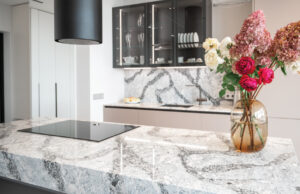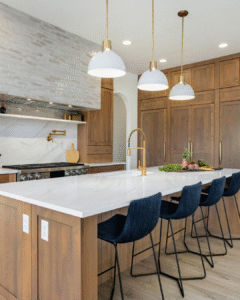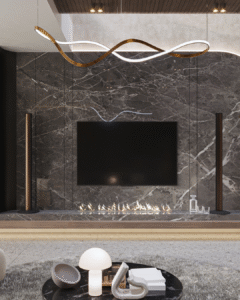
When choosing new countertops, most homeowners focus first on the stone.
Quartzite or quartz? Light or dark? Dramatic veining or something more subtle?
But there is another design decision that can have a surprisingly large effect on the finished kitchen: countertop thickness.
The thickness of a countertop changes its visual weight, the way it relates to cabinetry, and even whether a kitchen feels modern, traditional, understated, or architectural.
In the large kitchens and custom homes we see throughout Southlake, those proportions matter. A countertop that looks perfectly balanced on a smaller perimeter cabinet can feel completely different when stretched across an oversized island.
At Hard Rock Custom Countertops, we think thickness should be considered as part of the overall design—not simply treated as a technical specification.
Here is what Southlake homeowners should know.
1. Start With the Two Thicknesses You Will See Most Often
For many stone and quartz products, two common slab thicknesses are approximately 2 centimeters and 3 centimeters.
That translates roughly to:
- 2 cm: about ¾ inch
- 3 cm: about 1¼ inches
Cambria, for example, offers both 2 cm and 3 cm quartz and describes the thinner profile as more streamlined while the thicker option creates greater visual presence.
But the thickness of the slab does not necessarily dictate how thick the finished countertop has to look.
Through custom fabrication, the edge can sometimes be designed to create a much thicker visual profile.
That is where things get interesting.
2. A Thinner Countertop Can Make a Kitchen Feel Lighter
A thinner countertop profile tends to create a cleaner, more streamlined appearance.
In a contemporary Southlake kitchen with flat-panel cabinetry, minimal hardware, open shelving, or sleek architectural lines, a thinner surface can reinforce that design.
It allows the countertop to feel almost like a horizontal plane resting above the cabinetry rather than a heavy architectural element.
This approach can work particularly well with:
- Contemporary cabinetry
- Floating vanities
- Minimalist kitchens
- Waterfall applications
- Modern wet bars
- Subtle quartz patterns
- Clean, monochromatic interiors
Cambria similarly notes that 2 cm surfaces can reduce visual bulk and create a more refined, modern appearance.
The important point is that thinner does not automatically mean less luxurious.
In the right room, restraint can look extremely custom.
3. A Thicker Countertop Adds Visual Weight
A thicker profile does the opposite.
It gives the countertop more presence.
On a large kitchen island, that extra visual weight can help anchor the center of the room and make the island feel more substantial.
This is particularly useful in many Southlake kitchens because the proportions themselves tend to be larger—tall ceilings, oversized islands, substantial cabinetry, large pendant lights, and open living spaces.
A countertop that is visually too thin can sometimes feel undersized against those elements.
A more substantial edge can help balance:
- Large islands
- Tall cabinetry
- High ceilings
- Heavy architectural details
- Oversized lighting
- Wide appliance walls
- Large open-concept rooms
The countertop becomes part of the architecture rather than simply a surface sitting on top of cabinetry.
4. The Island and Perimeter Countertops Do Not Have to Match
One of our favorite ways to use countertop thickness is to intentionally differentiate the kitchen island from the perimeter.
For example, you might use a more restrained profile around the perimeter and give the island a visibly thicker edge.
That immediately tells the eye:
This is the focal point.
Cambria specifically identifies varying thickness between perimeter countertops and a statement island as a way to create visual hierarchy within a kitchen.
This works especially well when the island already has a different cabinet color or countertop material.
Imagine:
White oak island + dramatic quartzite + substantial edge
paired with
Painted perimeter cabinets + quieter stone + simpler profile
Neither surface has to compete with the other.
Instead, the design establishes a clear star.
5. A Mitered Edge Can Create a Much Thicker Look
If you love the look of an especially substantial countertop, that does not necessarily mean you need an unusually thick slab.
A mitered edge can be fabricated to make the countertop appear significantly thicker.
Rather than simply exposing the edge of the slab, additional material is carefully joined at an angle along the perimeter, creating the appearance that the entire countertop is much deeper.
When executed properly, the result can look like one massive piece of stone.
This technique is particularly striking with stones that have strong movement or veining because skilled fabrication can help carry the pattern through the edge.
Cambria likewise describes mitered fabrication as a technique that can make standard slab material appear substantially thicker.
6. Thick Countertops Can Turn an Island Into Furniture
There is a point where a countertop stops looking simply like the top of a cabinet and starts making the island feel like a custom furniture piece.
A substantial mitered edge can create that effect.
This can work particularly well on:
- Oversized kitchen islands
- Waterfall islands
- Bar-height seating areas
- Large rectangular islands
- Islands with integrated dining tables
- Statement quartzite installations
In a large Southlake kitchen, those added inches of visual thickness can make the island feel proportionate to the room.
That said, thicker is not always better.
A very heavy-looking countertop paired with ornate cabinetry, dramatic flooring, statement lighting, and heavily veined stone can sometimes give the eye too much to process.
The entire room still needs balance.
7. Countertop Thickness Changes How You See the Stone
Thickness also changes how the material itself is perceived.
Consider a quartzite with dramatic horizontal movement.
With a simple edge, your attention may remain almost entirely on the top surface.
Give that same countertop a deep mitered edge and the vertical face becomes another place to showcase the stone.
This is particularly important at an island, where the countertop edge is highly visible from the surrounding living areas.
The profile can make the stone feel more dimensional and emphasize that you are looking at a natural material rather than just a patterned surface.
8. Thickness and Edge Profile Work Together
Countertop thickness should not be selected independently from the edge profile.
An eased edge, bevel, bullnose, ogee, or mitered profile can look very different depending on the amount of material available.
For a clean transitional or contemporary Southlake kitchen, a simple eased edge on a 3 cm slab may provide plenty of presence without becoming ornate.
For a more traditional kitchen, additional thickness can provide room for a more detailed profile.
Cambria notes that some more elaborate edge treatments require sufficient material thickness, while simpler edges tend to reinforce a cleaner contemporary aesthetic.
The key is to select thickness and edge together, not as two unrelated decisions.
9. Waterfall Islands Make Thickness Even More Noticeable
On a traditional countertop, you primarily see the edge from across the room.
On a waterfall island, the stone turns downward and continues toward the floor.
Suddenly, thickness becomes much more prominent.
A carefully fabricated edge can make the transition from horizontal countertop to vertical waterfall panel feel clean and intentional.
And with strongly veined stone, the layout becomes particularly important.
A well-planned waterfall can make the veining appear to continue naturally down the side of the island, turning the stone itself into a major architectural feature.
This is one reason slab selection and fabrication planning should happen together.
You are not simply choosing a pretty slab.
You are deciding how that slab becomes part of the room.
10. Consider the Scale of Your Southlake Kitchen
One of the easiest mistakes to make is choosing countertop details in isolation.
A sample edge may look substantial when you are holding it in your hand.
Then you put that same detail into a kitchen with a 12-foot island, tall ceilings, oversized pendants, and floor-to-ceiling cabinetry—and suddenly it feels completely different.
Scale matters.
When planning a custom kitchen, consider:
- Island dimensions
- Ceiling height
- Cabinet style
- Cabinet thickness
- Appliance scale
- Pendant size
- Backsplash material
- Flooring
- Overall architectural style
Countertop thickness should support those elements, not fight with them.
11. Don’t Automatically Assume Thicker Means Better
There has been a strong move toward substantial-looking countertops in luxury kitchens, but that does not mean every Southlake kitchen needs a massive edge.
Sometimes a slimmer profile is exactly what makes the room sophisticated.
A beautiful marble or quartzite with dramatic veining may already command enough attention. A simple edge can allow the material to speak for itself.
Likewise, a smaller wet bar or vanity may look more refined with a lighter countertop profile.
Good custom design is not about adding the most expensive or dramatic option everywhere.
It is about choosing the details that make sense together.
12. Fabrication Is What Turns Thickness Into a Design Feature
This is also why choosing a countertop fabricator matters.
The slab is only the starting point.
Measurements, edge fabrication, mitering, seam placement, vein alignment, overhangs, support, installation, and finishing all determine whether the final countertop looks intentional.
At Hard Rock Custom Countertops, we help homeowners think about those decisions before fabrication begins.
That can mean keeping a perimeter understated while making the island more substantial. It can mean carrying a dramatic vein through a mitered edge. Or it can mean deciding that a simple 3 cm profile is exactly what the room needs.
The right answer depends on the stone, cabinetry, room, and overall design.
The Small Detail That Can Change the Entire Kitchen
Countertop thickness is easy to overlook when you’re standing in front of hundreds of beautiful slabs.
But once the countertops are installed, it becomes part of the way you experience the entire kitchen.
A thin profile can feel clean and contemporary.
A traditional 3 cm edge can feel substantial without demanding attention.
A deep mitered edge can turn a large island into an architectural centerpiece.
For Southlake homeowners designing or remodeling a kitchen, it is worth thinking beyond which stone do I want?
Also ask:
How do I want that stone to look once it becomes part of my home?
At Hard Rock Custom Countertops, we help homeowners throughout Southlake and DFW with material selection, custom fabrication, and installation so details like slab layout, edge profile, and countertop thickness work together in the finished space.
Because sometimes an inch or two can completely change the way a kitchen feels.
Resources
Southlake homeowners comparing countertop thicknesses and materials can explore full slabs through DFW suppliers such as Verona Marble Company, KLZ Stone Supply, Hilltop Stones, and Daltile. Cambria’s countertop thickness guide is also a useful visual resource for understanding how 2 cm, 3 cm, and mitered countertop profiles can change the overall appearance of a kitchen.