Choosing countertops often starts with a simple question: granite, quartzite, marble, or quartz?
But once you arrive at a stone yard and see rows of full-size slabs, the decision becomes much more specific. Two slabs with the exact same stone name can look surprisingly different, particularly when you are working with natural stone.
That is why, at Hard Rock Custom Countertops, we encourage our Southlake and DFW homeowners to look beyond a small sample or inspiration photo and carefully evaluate the actual slabs they are considering whenever possible.
Before you fall in love with a slab, here are 10 things to look for at the stone yard.
1. Look at the Entire Slab, Not Just a Sample
A small sample can help you narrow down colors, but it rarely tells the entire story.
Natural stone varies from slab to slab, and large-format engineered designs can have movement that simply cannot be captured in a few-inch sample. The Natural Stone Institute specifically recommends viewing the actual slabs because doing so allows homeowners to see the stone’s full color, veining, and movement.
Even engineered materials can vary dramatically across a full surface. Cambria, for example, cautions that a small sample may not display all of the characteristics visible in the finished slab.
Step back several feet and look at the slab as a whole. That is much closer to how you will experience it once it becomes a kitchen island or perimeter countertop.
2. Pay Attention to the Direction of the Veining
That dramatic vein running through the slab may be exactly what made you stop walking.
Now imagine where you want it to go.
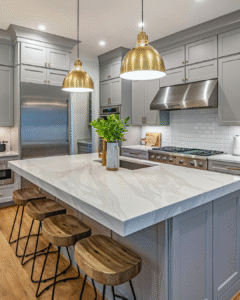
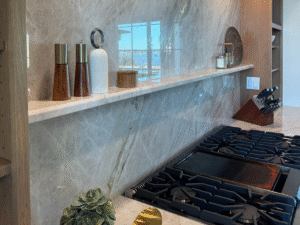
If you have a large kitchen island, waterfall edge, full-height backsplash, or another focal point in your Southlake home, the direction and location of the veining can significantly affect the finished design.
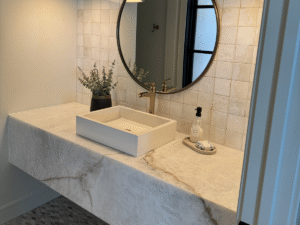
A skilled fabricator can help determine how the countertop pieces should be positioned within the slab to showcase the areas you love. With multiple slabs, careful planning may also allow veins to visually continue from one surface to another. Vein matching is commonly used in applications such as waterfall countertops to create a more continuous appearance.
Do not just ask, “Do I like this slab?”
Ask, “What part of this slab do I want to see in my kitchen?”
3. Check How Many Slabs Your Project Will Require
Before selecting anything, know approximately how much material your project requires.
A large Southlake kitchen with an oversized island, perimeter countertops, a wet bar, butler’s pantry, or full-height backsplash may require multiple slabs.
If that is the case, look at the slabs together.
Natural stone is inherently unique. One slab may contain considerably more movement, veining, or color variation than the slab sitting immediately behind it.
Whenever possible, select slabs from the same bundle and make sure you are comfortable with how they coordinate before reserving them.
4. Look for Fissures, Pits, and Natural Characteristics
One of the most common mistakes when shopping for natural stone is assuming every mark in a slab is a defect.
It isn’t.
Natural stone is created through geological processes, and fissures, mineral deposits, pits, color shifts, and other characteristics may simply be part of the stone. The Natural Stone Institute notes that many natural stones contain micro-fissures and other characteristics that are sometimes perceived as imperfections even though they are naturally occurring features of the material.
There is also an important distinction between a naturally occurring fissure and a crack caused by handling or fabrication.
If something concerns you, do not immediately reject the slab. Ask your fabricator or stone professional what you are seeing and whether it affects fabrication, durability, or simply the appearance of the stone.
5. Examine the Slab in Different Lighting
Stone can change dramatically depending on the light around it.
A warm showroom light, bright warehouse door, direct Texas sunlight, and the lighting in your kitchen can each bring out different undertones.
A seemingly pure white slab may reveal warm cream or gray tones. A dark quartzite may show blue, green, or metallic undertones that were not immediately obvious.
If you are coordinating countertops with white oak cabinets, painted cabinetry, flooring, backsplash tile, or a specific paint color, bring samples with you when possible.
Look at them next to the slab rather than relying on memory.
6. Think About Where Seams May Go
Homeowners understandably want as few visible seams as possible, particularly on statement islands.
But slab dimensions and the layout of your kitchen ultimately determine what can be fabricated from a single piece.
Before committing to your material, discuss the approximate layout with your countertop fabricator. A particularly beautiful slab is not necessarily the best slab for your project if its dimensions or pattern make the desired layout difficult.
This becomes especially important with:
- Oversized islands
- Long countertop runs
- Waterfall edges
- Dramatic directional veining
- Full-height stone backsplashes
The goal is not simply finding beautiful material. It is finding beautiful material that works with your specific kitchen.
7. Decide Whether You Want Movement or Consistency
There is no universally “best” slab.
There is only the slab that works best for the look you want.
Some Southlake homeowners want dramatic quartzite with bold movement that immediately becomes the focal point of the kitchen. Others want quiet, subtle countertops that complement custom cabinetry, lighting, and architectural details without competing for attention.
Before entering a stone yard, determine where you want the visual emphasis to be.
For a dramatic kitchen, look for:
- Bold veining
- Strong contrast
- Large-scale movement
- Distinct mineral patterns
For a quieter design, consider:
- More consistent coloring
- Softer movement
- Finer veining
- Lower-contrast patterns
Neither approach is better. The important part is making the decision intentionally.
8. Ask About the Finish
Polished is not your only option.
Depending on the material, slabs may also be available in honed, leathered, brushed, or other specialty finishes.
The finish can change not only the texture but also the way you perceive the stone’s color and movement.
A polished surface generally reflects more light and can emphasize color and veining. A honed or leathered surface may create a softer, more understated appearance.
If you love a particular stone but something about it feels slightly too formal, glossy, or dramatic, ask whether another finish is available before ruling it out.
9. Consider How the Stone Will Actually Be Used
The most beautiful slab in the warehouse is not automatically the best countertop for your household.
Think about your everyday life.
Is this going into a heavily used family kitchen? A primary bathroom? An outdoor entertaining area? A wet bar that is used occasionally?
Different materials have different maintenance characteristics, and some natural stones may require sealing or more careful maintenance than others.
Your fabricator can help you balance the appearance you want with the way your family actually uses the space.
The right question is not simply:
“Which stone is the prettiest?”
It is:
“Which stone will I still be happy I chose five years from now?”
10. Do Not Reserve the Slab Until You Understand the Fabrication Plan
This is the step that brings everything together.
A slab is raw material. Fabrication determines how that material becomes your countertop.
Before making a final decision, it helps to understand:
- Approximately how many slabs you need
- Where major countertop pieces may be positioned
- How prominent veins can be featured
- Whether seams will be necessary
- Whether waterfall edges or backsplashes require additional material
- How your preferred edge profile affects the finished appearance
That is also why working with your countertop fabricator during the material-selection process can make such a difference.
At Hard Rock Custom Countertops, we help homeowners throughout Southlake and the Dallas-Fort Worth area move from material selection through templating, fabrication, and installation. Our team can also accompany customers to DFW stone distributors to help evaluate slabs with the finished project in mind.
The Best Slab Is the One That Works for Your Home
Visiting a stone yard should be one of the most enjoyable parts of designing your new kitchen or bathroom.
Take your time. Walk around the slab. Look at it from a distance. Move closer. Study the veins. Compare neighboring slabs. Bring your cabinet and flooring samples.
Most importantly, think beyond how the slab looks standing vertically in a warehouse.
Imagine where the veining will fall across your island. Think about how the stone will look against your cabinets in the morning sun. Consider which portions you want to become focal points and where seams can disappear into the design.
That is how you go from selecting a beautiful slab to creating a countertop that feels like it was chosen specifically for your home.
Planning new countertops in Southlake, Colleyville, Grapevine, or elsewhere in DFW? Contact Hard Rock Custom Countertops for help selecting, fabricating, and installing stone that works beautifully with your space.
Sources & Local Stone Resources
Southlake homeowners have access to several excellent stone suppliers throughout the Dallas-Fort Worth area. Verona Marble Company offers an extensive selection of natural and engineered stone, including granite, quartzite, marble, quartz, and porcelain. KLZ Stone Supply in Dallas is another excellent resource for homeowners looking to view quartzite, granite, marble, quartz, porcelain, dolomite, and other specialty slabs in person. For an additional local option, Hilltop Stones has a Dallas-area showroom in Farmers Branch and offers granite, marble, quartzite, quartz, porcelain, and other premium surfaces. Daltile’s Dallas Stone & Slab Center also carries a wide range of natural stone and countertop materials, while Ann Sacks Dallas is a great destination for homeowners seeking distinctive luxury slabs and design-forward materials. For engineered quartz, Cambria provides another excellent option for comparing colors and designs. Visiting these DFW suppliers allows Southlake homeowners to see full slabs, compare natural variation and veining, and select a material with the finished kitchen or bathroom in mind.